


The New Zion
The title of this post is taken from a painting I purchased in 2022 from Gustavo Dias Sozo, a Madrid artist originally from Cuba. I discovered his artwork on Instagram because we both reference the Tower of Babel in our artwork. See my Global City Babel Series. Gustavo’s ant-like humans wait in bureaucratic lines, subjected to God-fathers, Patriarchs and the State/Babel. He gets the “human condition.”

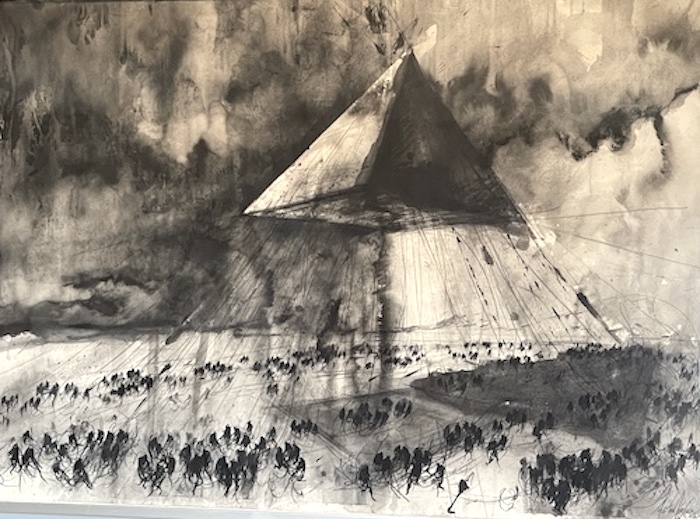
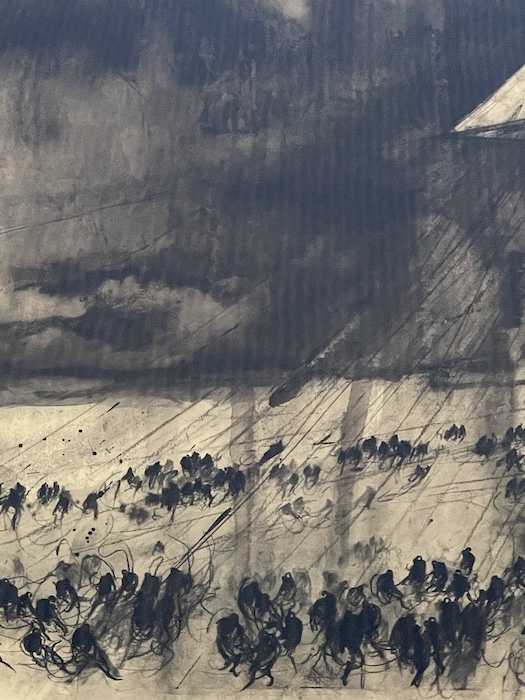
But Gustavo’s title, “The New Zion,” intrigued me. His usual Babel images were replaced by a foreboding pyramid hovering over small humans who were tethered to it, trying to control it like a large kite. Like The Tower of Babel narrative found in Genesis 11, it suggested the desire of humans to control their own destiny and create God’s Word on their terms. Gustavo’s “New Zion” was dark. It seemed an ironic commentary on the true Biblical Zion. It certainly was not a picture of the heavenly city of God. Like his Babel paintings, it portrayed man seeking his own dark devices to control God’s true story of redemption — Biblical Zion co-opted by the “New Zion.”
Biblical Zion is the city of God where God’s people celebrate King Jesus. And those who believe in Jesus are true Israel. Jesus came to institute a “new covenant,” the covenant of his blood ” (Luke 22: 19-20).
Zion and Israel are both Biblical terms that refer to God’s spiritual kingdom and spiritual people. These two words have been falsely understood by many Christians today. I hope to clarify the meaning of Israel and the New Covenant of the blood of Jesus in this post. Gustavo’s painting clearly showed me that the alternative is dark.
“We have not come to Mount Sinai,” says the apostle in the New Testament, “but to Mount Zion, and to the city of the living God, the heavenly Jerusalem,” (Hebrews 12:22).
Peter quotes Isaiah 28:16, foreshadowing Christ as the Cornerstone of Zion. “See I lay a stone in Zion, a chosen and precious cornerstone, and the one who trusts in him will never be put to shame” (1 Peter 2:6).
The First Advent and the “new covenant of Jesus blood” (Luke 22: 19-20) was shocking to Jesus’ disciples and the Jewish leaders. When Jesus said he could destroy the temple and raise it up in three days (John 2:16ff), he was referring to his body as the temple and his sacrificial death and resurrection, not Herod’s earthly temple steps on which he was standing and that had taken 46 years to build (watch video later for an interesting rabbit trail).
When Jesus was alive on earth, Palestine was ruled by Herod, a Roman king. He had decided to enlarge the Jewish temple and beautify the temple mount. He wanted to make it a wonder of the ancient world (20-18 BC), not for God’s glory. This temple was by no means Solomon’s temple of the Old Testament, which was destroyed by the Babylonians in 587 BC. The Holy Place was empty. because the Ark of the Covenant had been lost.
And the primary reason for the temple where God met with his people would soon be over as Jesus foretold. Jesus would become the true temple and his blood sacrifice a new and living way to know God! He would create a temple of living stones.
For some perspective about this splendid temple Jesus was denouncing and why they thought Jesus’ statement was crazy, watch video.
Jesus said, “Not one stone shall be left upon another,” (Luke 21:3). He told them that these things would happen soon. Herod’s temple was completely razed by the Roman Empire after the Jewish-Roman wars (66-73 A.D), as Jesus had told his disciples. And soon after this he was crucified and died, instituting “the new covenant of his blood” (Luke 22: 19-20).
Six centuries before Jesus came, Jeremiah the prophet told the Jewish leaders that the temple would come to an end, and that God would make a new covenant with the house of Israel.
“But this is the covenant that I will make with the house of Israel after those days, says the LORD; I will put my law in their minds and write it on their hearts and I will be their God and they shall be my people,” Jeremiah 31:33.
Jesus’ death and resurrection was the cataclysmic end of Old Covenant sacrifices and Old Testament Israel. It was the beginning of the New Covenant and new Israel, the people of God, from all nations tribes and tongues.” The Word of God is clear that Zion would be the sole possession of the Lord Jesus, now and when he returns as victorious king.
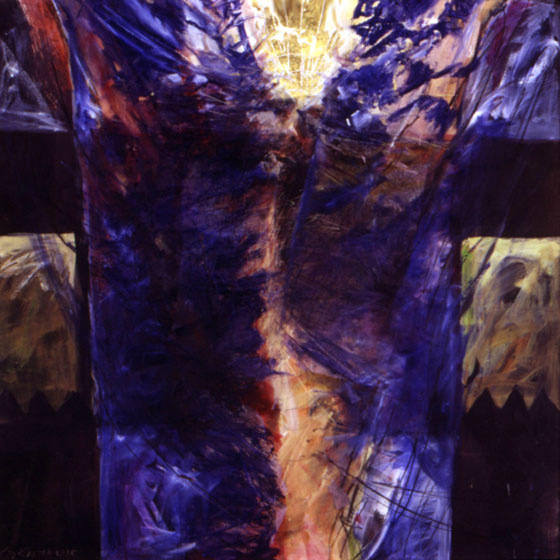
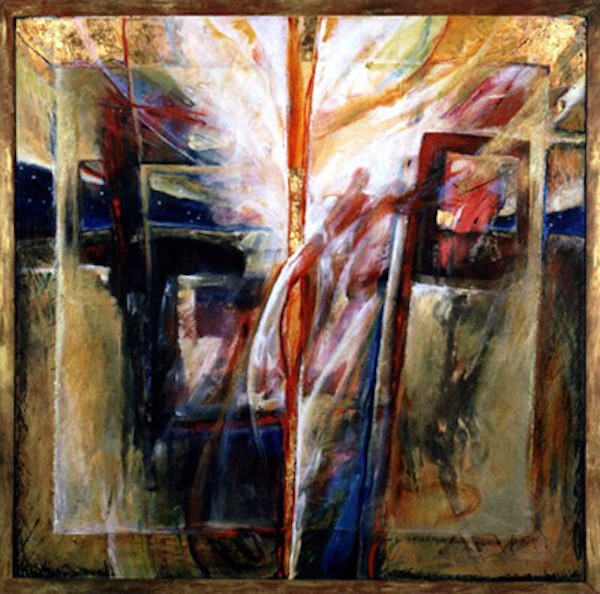
The following two paintings were part of my Christmas invitational show at the Asheville Art Museum in 1993.
“By a New And Living Way Through The Veil That Is His Flesh”
48 x 48 inches (Dallas Collection 1995)
“He Has Opened Heavens Door And Man is Blessed Forevermore”
48 x 48 inches (Raleigh, NC, 1993)
Jesus is the true temple of God.
He is God incarnate who came to dwell / tabernacle with in his people, (John 1:9-14).
And after he ascended to heaven, ruling from the right hand of the Father, he sent God the Holy Spirit to live in human living temples whose hearts are his.
The New Covenant “people of God,” (Israel) are the organic continuation of the Old Testament “people of God”.
“There is neither Jew nor Greek, there is neither slave nor free, there is neither male nor female; for you are all one in Christ Jesus. And if you are Christ’s then you are Abraham’s seed, heirs according to the promise,” Galatians 3:28,29.
“The New Covenant” 30 x 40 inches oil and wax on canvas
(collection of Bowie Art Center, Erskine College, Due West, SC)
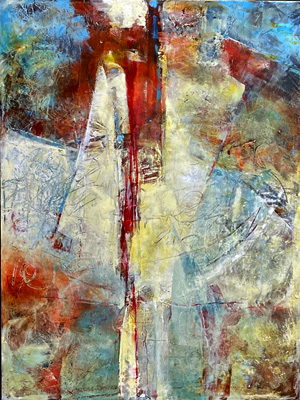
Before understanding how “New Zion” has deceived the church, here are more Scriptural references about this decisive shift in redemptive history from the Old Covenant community (Sinai) to the New Covenant church (Zion).
The apostle Paul explains it when he compares the Old Covenant to Hagar and the New Covenant to Sarah.
“Now this may be interpreted allegorically: these women are two covenants. One is from Mount Sinai, bearing children for slavery, she is Hagar. Now Hagar is Mount Sinai in Arabia; she corresponds to the present Jerusalem, for she is in slavery with her children. But the Jerusalem above is free and she is our mother, . . . Cast out the slave woman and her son for the son of the slave woman shall not inherit with the son of the free woman,” Galatians 4: 21-31.
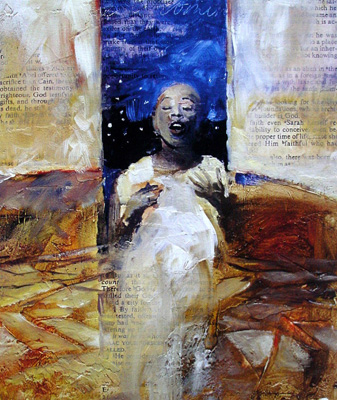
In this painting, Sarah stands singing in a parched and barren landscape. She is included in the heroes of faith Hebrews 11. “By faith, Sarah herself received power to conceive, even when she was past the age, since she considered him faithful who had promised. (this text is included in the top of the painting) God made a covenant with Abraham that his Seed would be as numerous as the stars in heaven.
“Abraham’s Seed”
(available as a giclee print)
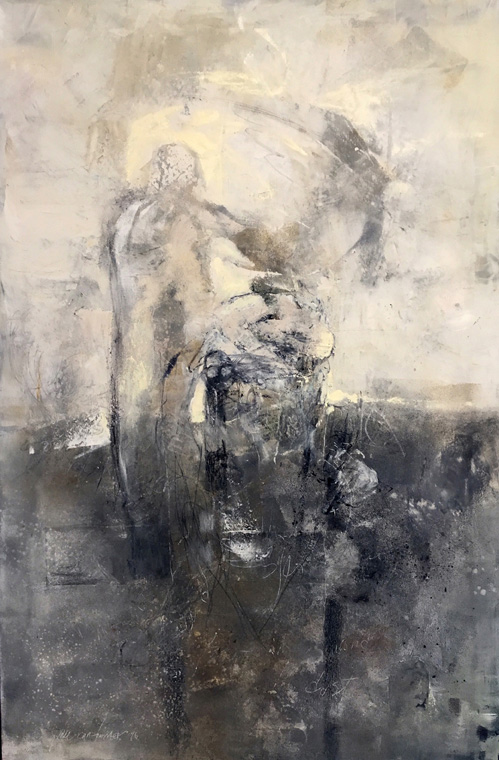
God’s plan of redemption is made clear from Genesis to Revelation. In Genesis 22:15ff, we read about Abraham’s sacrifice of his only son, a foreshadowing of the sacrifice of God’s only Son.
“Then the angel of the LORD called to Abraham and said: “By Myself I have sworn, says the LORD, because you have done this thing, and have not withheld your son, your only son — “blessing, I will bless you and multiplying, I will multiply your descendants as the stars of the heaven. . . In your seed all the nations of the earth shall be blessed, because you obeyed My voice.”
“The Sacrifice”
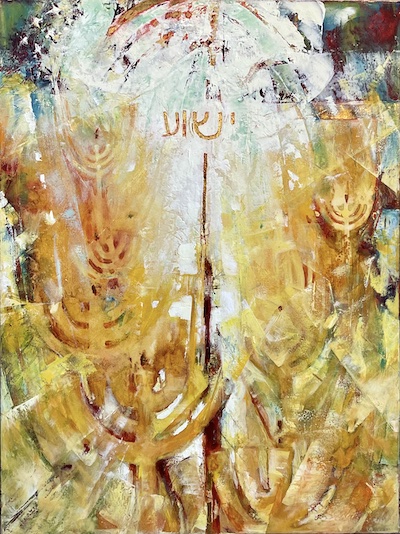
In Revelation 21:22 , John sees a vision of Jesus. He does not see a temple; he sees “The Lord God Almighty, and The Lamb are its temple.” Jesus is standing in the midst of his complete and perfected bride symbolized by seven golden lampstands.
“The Vision of the Seven Golden Lampstands” 36 x 48 inches
The entire cannon of Scripture is God’s Word of salvation to man. It shows us Jesus, God Incarnate, from Genesis to Revelation. Genesis 12: 1-3 records the Lord’s initial call to Abram, who was a Gentile pagan living in Mesopotamia. God chose him to receive the promises of land, descendants, and a great name. God created a people for himself by first choosing Israel from among all the nations and then blessing all nations of the earth through this nation. Isaiah 42 foretells of Jesus who would bring justice to the nations.
“Behold! My Servant whom I uphold, My Elect One in whom My soul delights! I have put My Spirit upon Him. He will bring forth justice to the Gentiles . . . And the coastlands will wait for His law” (Isaiah 42).
The New Covenant Changed Everything
The New Covenant changed everything, especially our understanding of Israel After Jesus’ First Advent, Jerusalem was leveled by the Romans (70 AD). Because of Romans’ persecution, the gospel spread quickly to “the coastlands” thoughout the empire. The gospels and “letters” to new believers were written. Luke, who wrote the book of Acts (of the Apostles) also wrote the letter to the Hebrews /Jewish believers. Paul wrote Romans to the church in Rome. Peter, a disciple of Jesus, begins his letter, “Peter, an apostle of Jesus Christ to the pilgrims of the Dispersion in Pontus, Galatia, Cappadocia, Asia, and Bythynia (Turkey today), elect according to the foreknowledge of God the Father in sanctification of the Spirit, for obedience and sprinkling of the blood of Jesus Christ: Grace to you . . . . ” Paul also tells of meeting with Jews and Gentiles as the gospel spread.
By 312 A.D, the Roman emperor Constantine was converted to Christianity. From 492-1492 (a millennium), the gospel spread and flourished. Beautiful churches were built in Palestine and the Byzantine Empire, as church bishops hammered out biblical creeds. (We still use the Nicene Creed today, which clarified the Biblical doctrine of the Trinity. The Council of Nicaea happened in 325.)
Emperor Justinian further cemented Christianity as the official religion of the Byzantine Empire. The intellectual achievements of his reign were significant. Art and literature flourished under his rule, and his officials carried out a remarkably thorough synthesis of Roman law that has served as the basis of the legal systems of much of Europe up to the present day. The Hagia Sophia / Church of the Holy Wisdom in Constantinople (Istanbul today) was built between 532 and 537. The interior of this building is a beautiful wonder.
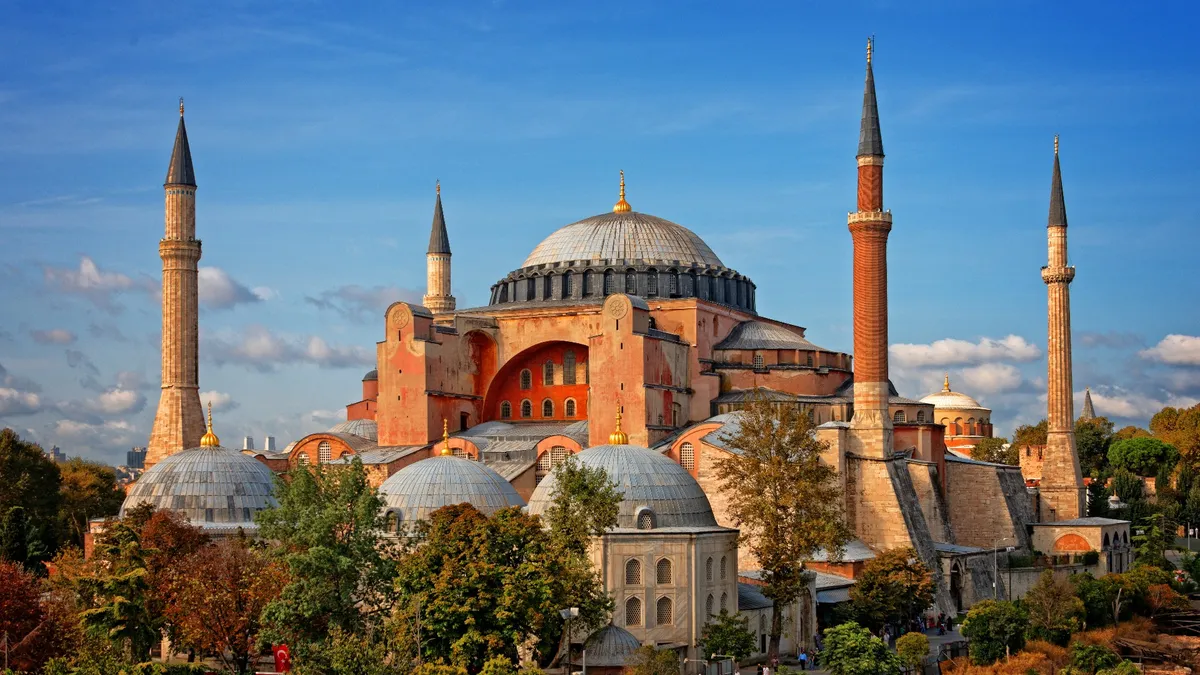
1000 years of Christendom (Byzantine Empire) were not the “Dark Ages” as our rewritten history texts teach. Rather, the Christian gospel flourished from 395-1453 before falling to an Ottoman Turkish Empire in the 15th century as the Christian faith spread westward.
Palestine too was conquered by the Ottomans, who unified it under Islam. It remained under Muslim rule til 1900, although the Crusaders captured Jerusalem for a short time. Selim I ruled Palestine for 400 years until the late 1800’s when England and the Zionists began their interest in this crucial crossroads. Zionism began in the early 1800s.
(Palestine under Ottoman control was opposed to Zionism even before World War I. They sought an end to Jewish immigration and the land purchases by Zionists, mostly subsidized by the French philanthropist Edmond, baron de Rothschild. Land purchases rose from 19 in 1900 to 47 in 1918. Here is a statistic from 1914. The population of Palestine was about 690,000 (535,000 Muslims; 70,000 Christians, most of whom were Arabs; and 85,000 Jews).
What is Zionism (“The New Zion”) and how did it develop?
In 1899 Napoleon promised Jewish people a “new homeland.” But this “promise” began more than fifty years earlier, when Christian “restorationists” in England, were helped by Theodor Hershl, who organized and propagandized for the Jewish State. When Britain defeated France, “Christian Zionism” became useful to their geo-political aspirations.
To promote the desire for “an earthly home” for the Jews, a “new theology” called Dispensationalism was popularized by an Irishman named John Nelson Darby. His teaching that the Bible was divided into seven “dispensations,” and the church and Israel were two distinct groups, two distinct identities, helped with this plan. He taught that God would deal with the Jews after “the church age” or dispensation after the church was raptured. He reached this conclusion because he saw the church in ruins so its only hope was to escape this world. (Left Behind movies resulted from this theology.) World Wars I and II were certainly terrors to escape and also helped get the Jews to Palestine.
Put the political and religious aspirations together, and you can see how Zionism got its start.
But Zionism, both political Zionism and Christian Zionism, are not compatible with biblical faith. Rather than viewing the Scriptures as a whole as it had been taught for 1800 years since Jesus’ first Advent, Darby’s theology “disconnected” the Scriptures with these new “dispensations.” “Abraham’s seed” meant only his earthly descendants, not his spiritual heritage in Jesus. God’s people were no longer one people but divided between Gentiles and Jews. Jesus was not understood as fulfilling the prophecies of the Old Testament. God’s Word was not the unified story of God’s covenant of grace and redemption of a people for Himself, but it became man’s story.
Read about The Place of Israel by John Stott that explains this theology well. And this interview is also helpful.
Dispensationalism was introduced to America’s churches by the 1900s. Darby’s futurist theology was promoted by the Scofield Study Bible, which was published in 1909 in New York with the help of the Zionist movement. It quickly became the most influential statement of dispensational premillennialism. Scofield‘s popularity as Bible conference speaker took off. His role in getting the American church on board to promote a “promised land” for the Jews was enormous. And two world wars made “the rapture” very appealing.
Other groups were influenced by the teachings of Dispensationalism’s eschatology. Charles Taze Russell founded the Jehovah Witnesses. The Watch Tower Bible and Tract Society taught this unbiblical view of “end times.” Check out his tomb in this image. Definitely reminded me of Gustavo’s “New Zion.”
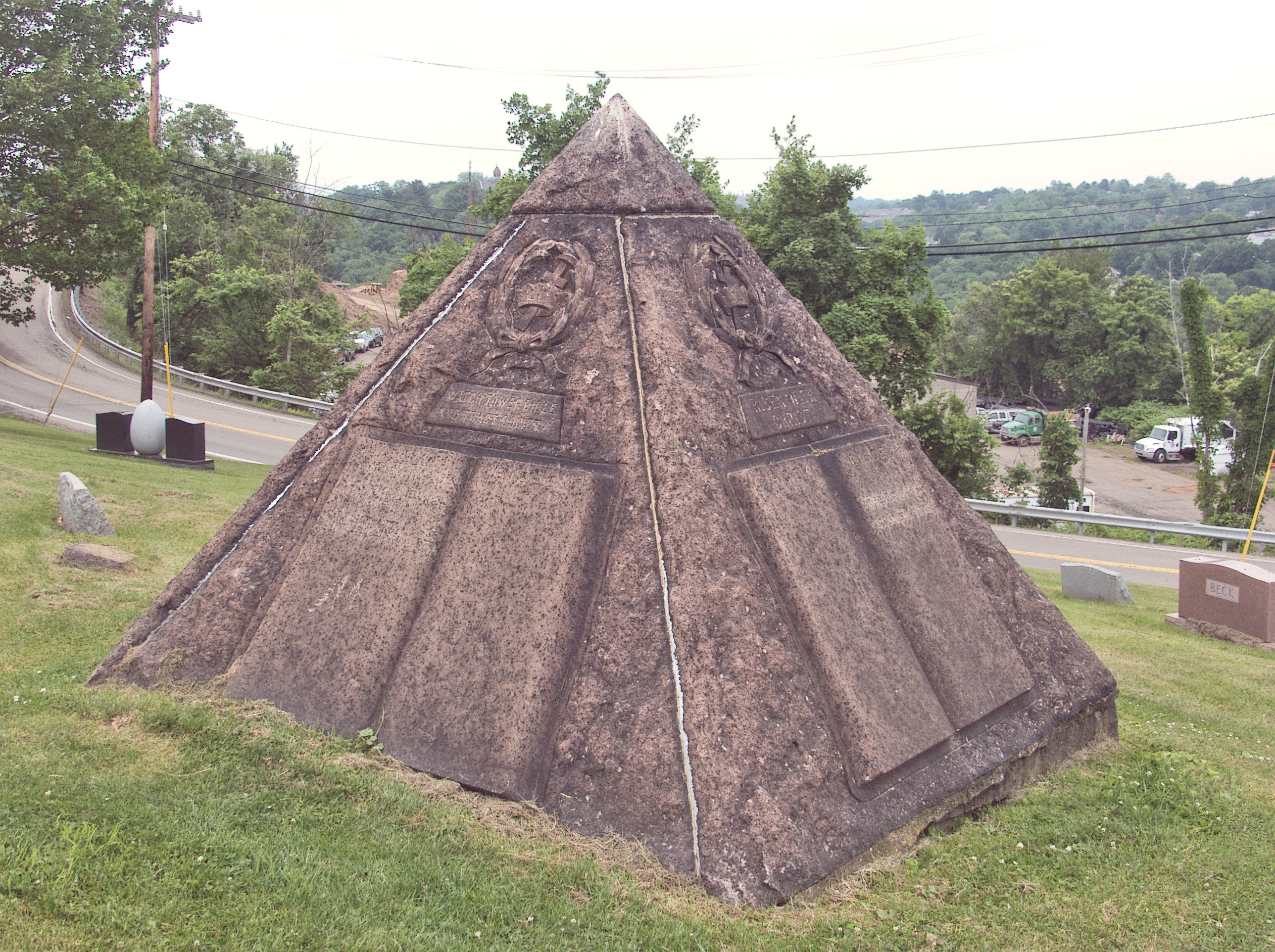
This theological view with help of American presidents, saw to it that the State of Israel was recognized in 1948. Since then, “The New Zion” has taken land belonging to native inhabitants. The American Israel lobby is a very powerful lobby in America’s government, supporting Zionist Israel, both financially and idealogically. Palestinian Christians have been slaughtered in Gaza, but the secular Zionist state sadly claims to be God’s chosen people and the “promised land” belongs to them.
The Old Testament promises about the land are nowhere repeated in the New Testament. The prophecy of Romans 11 is a prophecy that many many Jews will turn to Christ, but the land is not mentioned nor is Israel mentioned as a political entity. There is only one verse in the New Testament that has ever been regarded as a promise that the Jews will return to the land, and that is Luke 21:24 when Jesus says that Jerusalem is going to be trodden down by the gentiles until the times of the gentiles be fulfilled. That is an ambiguous verse, and it can be interpreted in two different ways. It could refer not to a period of gentile domination after which Jerusalem is going to be rebuilt, but the times of the gentiles could rather refer to the whole of the present world order until the end of history when Jesus will come again in power and great glory. But even that aside, there is no other verse that repeats the promises of the Old Testament. So we need to be very cautious in simply jumping back to the Old Testament promises and ignoring how they are handled in the New.
The Old Testament promises according to the apostles are fulfilled in Christ and in the international community of Christ. The New Testament authors apply the promise of Abraham’s seed to Jesus Christ. And they apply to Jesus Christ the promise of the land and all the land which is inherited, the land flowing with mild and honey, because it is in Him that our hunger is satisfied and our thirst is quenched. A return to Jewish nationalism would seem incompatible with this New Testament perspective of the international community of Jesus.
I’m sorry for this little parenthesis, especially if it has seemed controversial to some. (John Stott / The Place of Israel)
We know God oversees the pograms of men and “the raging nations.” Jesus is on the throne of heaven, ruling the affairs of men. He allows deception and wickedness to run its course. “Though the nations rage,” Psalm 2, God has set his King on Zion, his holy hill. The LORD rules and gather his people, “true Israel,” from across the world and he will suddenly appear bodily at Second Advent when every eye will see him!

The true Israel is not the modern secular nation-state of Israel, “The New Zion,” as Gustavo’s painting illustrates, but those who believe in Jesus.
Paul, a Jew himself, was traveling to Damascus when he met Jesus. He was on his way to persecute the Christ followers. He writes to the Ephesian church,
“Of this gospel (good news), I was made a minister according to the gift of God’s grace, which was given to me by the working of his power to me. Paul writes that ‘by revelation, God made known to him the mystery that both Jews and Gentiles would be “fellow heirs, of the same body and partakers of God’s promise in Christ through the gospel.” He was called to preach to the Gentiles the unsearchable riches of Christ and to bring to light for everyone what is the plan of the mystery hidden for ages in God, who created all things, so that through the church the manifold wisdom of God might now be made known to the rulers and authorities in the heavenly places . . . (Ephesians 3:9).
To the Galatian church he writes, “For neither circumcision counts for anything, nor uncircumcision, but a new creation.”
All the promises made to Israel belong to the church, which is made up of Jews and Gentiles who have trusted in Christ alone for salvation.
“But a Jew is one inwardly and circumcision is a matter of the heart, by the Spirit, not by the letter,” Romans 2:29. Paul writing to the Romans quotes Moses in the book of Deuteronomy, “The word is near you, in your mouth and in your heart” (that is, the word of faith which we preach): that if you confess with your mouth the LORD Jesus and believe in your heart that God has raised Him from the dead, you will be saved.”
In Jeremiah’s book, God calls Israel back to the LORD. “Return O backsliding children,” says the Lord, for I am married to you. I will take you, one from a city and two from a family, and I will bring you to Zion. New Jerusalem and “New Zion” shall be called “The throne of the LORD, and all nations shall be gathered to it, to the name of the LORD. No more shall they follow the dictates of their evil hearts,” Jeremiah 3:14-17.
“We Will Feast in the House of Zion”
24 x 24 oil and wax on panel
God’s bride is scattered across the world, awaiting the day when He will gather his own from every nation, Gentiles and Jews, “the remnant of Israel chosen by grace.”
“I don’t want you to be unaware of this mystery brothers, a partial hardening has come upon Israel until the fullness of the Gentiles has come in. And in this way all Israel will be saved as it is written,
“The Deliverer will come from Zion,… and this will be my covenant with them when I take away their sins,”
Romans 11:5.
“Great is the LORD and greatly to be praised in the city of our God!
His holy mountain, beautiful in elevation, is the joy of all the earth,
Mount Zion, in the far north, the city of the great King.
As your name O God, so your praise reaches to the ends of the earth.
Your right hand is filled with righteousness,
LET MOUNT ZION BE GLAD.”
(credit: Thank you Table Talk October 2023 devotional!)